

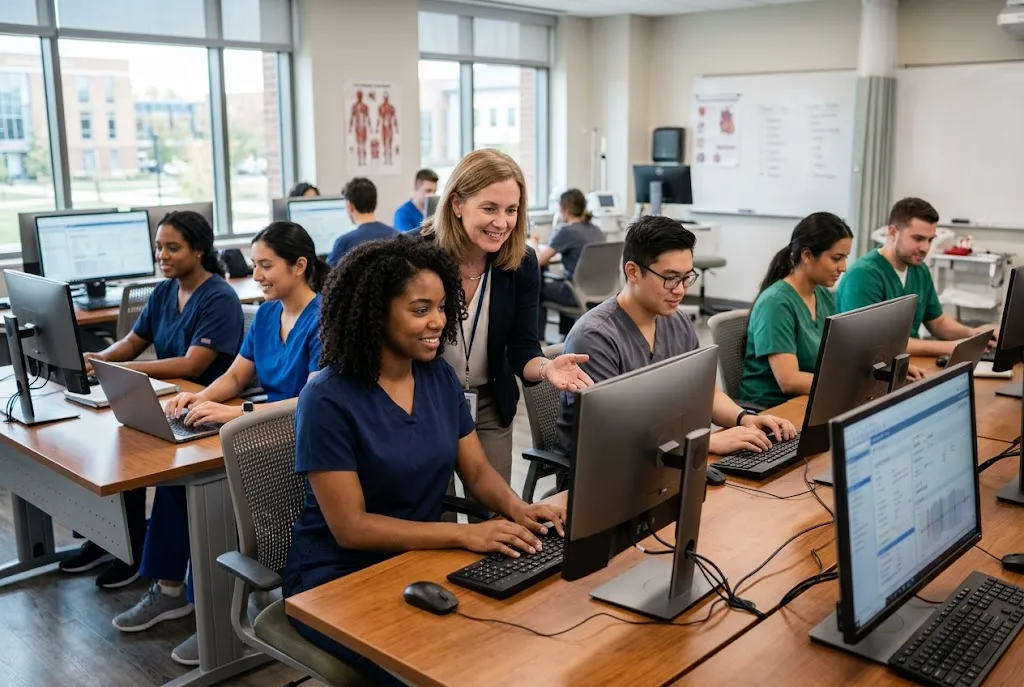
Healthcare education is changing alongside the technology used in modern clinical environments. Students are no longer preparing only through textbooks, lectures, and practical exercises. They are also learning how digital systems influence documentation, patient information, communication, and everyday healthcare workflows.
An Educational EHR can help bridge this gap by giving students a simulated environment where they can practice electronic documentation without working with real patient records.
For healthcare education programs, the value of these platforms goes beyond simply teaching students how to navigate software. When used effectively, they can support simulation, documentation practice, clinical reasoning, and broader digital literacy.
What Is an Educational EHR?
An Educational EHR is a simulated electronic health record environment created specifically for learning.
Unlike production healthcare systems, educational platforms allow students to work with simulated patients and scenarios. This provides a controlled environment where learners can practice reviewing information and completing documentation activities.
The approach can be useful for:
- Nursing education
- Medical assistant programs
- EMT training
- Healthcare simulation
- Allied health education
- Clinical documentation practice
The specific features vary between platforms, so educators should evaluate each option according to their curriculum.
Why Digital Healthcare Education Matters
Electronic health records are now deeply connected to modern healthcare workflows.
Students may encounter digital records during clinical placements, internships, and eventually their professional careers. Becoming familiar with electronic documentation during education can therefore provide useful preparation.
However, students should not simply learn one software interface.
A stronger educational approach is to teach the underlying concepts of digital documentation, patient information management, and electronic healthcare workflows.
1. Give Students a Safe Practice Environment
One of the main benefits of an educational EHR is the ability to practice without using real patient information.
Students can work through simulated scenarios and make mistakes without affecting actual patient care.
This creates opportunities to:
- Review patient records
- Practice documentation
- Explore simulated scenarios
- Repeat activities
- Receive feedback
The environment can therefore support learning through practice rather than passive observation.
2. Connect EHR Learning With Simulation
Digital records can become part of broader healthcare simulation.
For example, students might first review a simulated patient’s history before participating in a scenario. After completing the activity, they could document relevant information in the simulated record.
This creates a more complete learning sequence:
Review → Assess → Respond → Document → Reflect
The approach can help students see how documentation fits into patient care rather than treating the EHR as an isolated technology lesson.
3. Support Different Healthcare Programs
Healthcare education is diverse.
Nursing students, medical assistant students, EMT learners, and other healthcare students may have different learning objectives.
An educational EHR can be particularly valuable when it provides flexibility across multiple educational disciplines.
Institutions should therefore consider whether a platform can support different courses and levels of learners.
4. Improve Digital Documentation Skills
Documentation is an important part of healthcare communication.
Students need to understand how information is organized, recorded, and reviewed within digital systems.
Educational activities can introduce concepts such as:
- Patient histories
- Vital signs
- Medication information
- Clinical notes
- Assessment findings
- Other simulated patient data
Practicing these workflows in an educational environment can help students become more comfortable with digital documentation.
5. Help Educators Create Practical Assignments
Technology is most useful when it supports the instructor’s teaching goals.
Faculty may want students to complete specific activities based on a patient scenario or course objective.
An effective platform can allow educators to create or adapt learning activities rather than forcing every class to follow the same workflow.
Instructor-friendly controls can also make it easier to review student work and provide feedback.
6. Combine Technology With Traditional Learning
An educational EHR should complement traditional teaching methods.
Students still need lectures, textbooks, instructor guidance, practical exercises, and supervised clinical experiences.
Digital tools can provide another layer of practice.
For example, an instructor may teach documentation concepts during class and then assign a simulated patient-record activity afterward.
This gives students an opportunity to apply what they have learned.
7. Consider Free Educational Resources
Students often need additional learning materials outside scheduled classes.
Free resources can help learners review concepts, practice skills, and explore subjects in greater depth.
For example, healthcare students may benefit from:
- Free courses
- Digital textbooks
- Drug guides
- Simulation activities
- Documentation practice
- Study resources
ChartFlow provides a course catalog with student-focused healthcare education resources, including free learning opportunities.
8. Explore Healthcare Publishing Resources
Healthcare education also depends on accessible reference materials.
Students studying pharmacology, medications, or related subjects may benefit from digital textbooks and drug guides that supplement their coursework.
ChartFlow’s publishing platform provides educational resources including a pharmacy textbook, drug guide, and EMT drug guide.
Students looking for additional study materials can explore ChartFlow Publishing.
These resources can complement classroom teaching while giving learners additional opportunities for independent study.
9. Evaluate Ease of Use
An educational technology platform should not become an unnecessary obstacle.
Students have enough academic demands without spending excessive time learning complicated software.
Educators should evaluate:
- Interface simplicity
- Student navigation
- Assignment workflows
- Instructor controls
- Accessibility
- Technical support
A straightforward system can make adoption easier for both students and faculty.
10. Consider Long-Term Value
An institution may start using an EHR platform for one course and eventually expand it to additional programs.
Scalability should therefore be part of the evaluation process.
Administrators should consider whether the platform can support:
- More students
- More instructors
- Additional courses
- Multiple healthcare disciplines
- Larger simulation activities
Long-term planning can prevent institutions from having to replace technology when their educational needs change.
What Should Educators Look For?
Before selecting an educational EHR, educators can create a simple evaluation checklist.
Curriculum Alignment
Does the platform support the learning objectives of your courses?
Realistic Scenarios
Can students work with simulated patient information that reflects educational needs?
Documentation
Can learners practice relevant electronic documentation?
Instructor Tools
Can faculty create activities and review student work?
Accessibility
Can students access learning activities conveniently?
Scalability
Can the platform grow with the institution?
Support
Is help available when instructors or students encounter technical problems?
Overall Value
Does the platform provide enough educational value for its cost?
ChartFlow and Healthcare Education
ChartFlow is an example of a platform focused specifically on healthcare education and simulated EHR learning.
Its educational approach can help students become familiar with digital patient records while practicing healthcare documentation in simulated environments.
The platform also supports broader student learning through its course catalog and publishing resources.
For healthcare education programs exploring ways to connect digital EHR practice with student learning, these resources can provide an additional option to evaluate.
Why Founder-Led Healthcare Technology Can Be Different
Healthcare education technology is often developed by large organizations with extensive resources. Smaller founder-led companies can take a different approach by focusing closely on the needs of their users.
ChartFlow was founded by Daniel Shporin, who built the company from its early stages with a small team and a focus on healthcare education.
According to the company’s information provided for this campaign, ChartFlow has grown to serve around 200 nursing and health schools.
That type of focused development can be relevant for educational institutions evaluating technology designed specifically around healthcare education rather than adapting a general-purpose clinical system.
Questions to Ask Before Choosing an Educational EHR
Before making a decision, educators should ask:
- Does the platform fit our curriculum?
- Can students work with simulated patient records?
- Does it support documentation practice?
- Can it complement healthcare simulation?
- Can instructors create activities?
- Can faculty review student work?
- Can different healthcare programs use it?
- Is the interface easy for students?
- Are additional educational resources available?
- Can the platform scale as our program grows?
These questions can help schools compare platforms more effectively.
Final Thoughts
An Educational EHR can give healthcare students valuable experience with electronic documentation and simulated patient records.
The most useful platforms do more than reproduce a digital chart. They provide opportunities for students to apply knowledge, practice workflows, participate in simulations, and receive feedback from educators.
For institutions considering healthcare education technology, the decision should focus on curriculum alignment, usability, simulation support, documentation capabilities, instructor tools, and long-term value.
When digital EHR practice is integrated thoughtfully with traditional teaching and clinical education, it can help students become more prepared for the technology-driven healthcare environments they will encounter after graduation.